Loading...
Hardware Platform
The Trapped Ion Qubit
Individual atoms suspended in electromagnetic traps, manipulated with laser beams. Among the highest gate fidelities in quantum computing. All-to-all connectivity within a trap zone. Coherence times measured in minutes with dynamical decoupling. This is how IonQ and Quantinuum build quantum computers.
Coherence Time~1–10min
Gate Time~1–100
Gate Fidelity~99.9%
ConnectivityAll-to-all
Readout Fidelity~99.9%
Single-Qubit Fidelity~99.99%
* Minutes-scale coherence is a record achieved with hyperfine clock states under dynamical decoupling; typical operating T₂* is shorter.
History & Origins
From Wolfgang Paul's electromagnetic trap to the highest-fidelity quantum computers on Earth.
The story of trapped-ion quantum computing begins in 1953, when Wolfgang Paul invented the quadrupole ion trap — a device that uses oscillating radio-frequency (RF) electric fields to confine charged particles in free space[5]W. Paul (1990). Electromagnetic traps for charged and neutral particles. Rev. Mod. Phys. 62, 531–540.. The trap works by creating a saddle-shaped potential that oscillates rapidly: the ion is unstable in one direction and stable in the other, but the rapid switching creates a net confining force. Paul shared the 1989 Nobel Prize in Physics with Hans Dehmelt for this invention.
For decades, ion traps were tools for precision spectroscopy and mass spectrometry. Then in 1995, Juan Ignacio Cirac and Peter Zoller at the University of Innsbruck published a landmark paper proposing that trapped ions could be used for quantum computation[2]J. I. Cirac & P. Zoller (1995). Quantum Computations with Cold Trapped Ions. Phys. Rev. Lett. 74, 4091–4094.. Their scheme used a linear chain of ions, each encoding a qubit in internal atomic states, with collective vibrational modes serving as a quantum bus for entangling gates. The same year, Chris Monroe and David Wineland at NIST demonstrated the first controlled-NOT gate between the internal and motional states of a single trapped ⁹Be⁺ ion — proving the concept experimentally[6]C. Monroe et al. (1995). Demonstration of a fundamental quantum logic gate. Phys. Rev. Lett. 75, 4714–4717..
The original Cirac–Zoller gate was elegant but experimentally demanding: it required the ion chain to be cooled to its motional ground state and addressed with a sequence of precisely timed laser pulses. In 1999, Sørensen and Mølmer introduced a much more robust scheme — the Mølmer–Sørensen (MS) gate — that uses two laser tones tuned to the red and blue motional sidebands to create a spin-dependent force[4]A. Sørensen & K. Mølmer (1999). Quantum Computation with Ions in Thermal Motion. Phys. Rev. Lett. 82, 1971–1974.. The MS gate is far more tolerant of thermal motion and became the workhorse entangling gate for virtually all trapped-ion quantum computers.
1953–1989
The Paul Trap
Wolfgang Paul invents the RF quadrupole trap; wins Nobel Prize in 1989[5]W. Paul (1990). Electromagnetic traps for charged and neutral particles. Rev. Mod. Phys. 62, 531–540.
1995
Quantum Computing Proposed
Cirac-Zoller proposal and Monroe-Wineland first CNOT gate with trapped ions[2]J. I. Cirac & P. Zoller (1995). Quantum Computations with Cold Trapped Ions. Phys. Rev. Lett. 74, 4091–4094.[6]C. Monroe et al. (1995). Demonstration of a fundamental quantum logic gate. Phys. Rev. Lett. 75, 4714–4717.
2003–2025
Fidelity Revolution
Geometric phase gates exceed 99.9% fidelity; QCCD shuttling; commercial systems reach record two-qubit fidelities[11]D. Leibfried et al. (2003). Experimental demonstration of a robust, high-fidelity geometric two ion-qubit phase gate. Nature 422, 412–415.[13]C. J. Ballance et al. (2016). High-fidelity quantum logic gates using trapped-ion hyperfine qubits. Phys. Rev. Lett. 117, 060504.[14]J. P. Gaebler et al. (2016). High-fidelity universal gate set for ⁹Be⁺ ion qubits. Phys. Rev. Lett. 117, 060505.[9]J. M. Pino et al. (2021). Demonstration of the trapped-ion quantum CCD computer architecture. Nature 592, 209–213.
Since those first demonstrations, trapped-ion systems have achieved remarkable milestones. Geometric phase gates exceeded 99.9% fidelity by 2016[13]C. J. Ballance et al. (2016). High-fidelity quantum logic gates using trapped-ion hyperfine qubits. Phys. Rev. Lett. 117, 060504.[14]J. P. Gaebler et al. (2016). High-fidelity universal gate set for ⁹Be⁺ ion qubits. Phys. Rev. Lett. 117, 060505.. In 2021, Quantinuum demonstrated the QCCD (quantum charge-coupled device) architecture — shuttling ions between storage and interaction zones — on the H1 processor[9]J. M. Pino et al. (2021). Demonstration of the trapped-ion quantum CCD computer architecture. Nature 592, 209–213.. By 2025, Quantinuum's Helios system achieved a record 99.921% two-qubit gate fidelity with 98 barium-ion qubits and demonstrated 48 logical qubits using a high-rate encoded scheme[17]Quantinuum (2025). Helios: 98 barium-ion qubits, 99.921% two-qubit gate fidelity, 48 logical error-corrected qubits. Quantinuum Press Release & arXiv:2511.05465.. Separately, IonQ demonstrated 99.99% two-qubit gate fidelity on barium-ion EQC (Electronic Qubit Control) R&D prototypes[16]IonQ (2025). IonQ Tempo: 64 algorithmic qubits, 99.99% two-qubit gate fidelity demo with barium ions and EQC. IonQ Press Release & Technical Blog., while its Tempo system reached 64 algorithmic qubits on ~100 physical barium-ion qubits.
The Paul Trap
An electromagnetic cage that suspends individual atoms in free space. The RF quadrupole trap is the foundation of every trapped-ion quantum computer.
A trapped-ion qubit begins with a single atom — typically an alkali-earth or alkali-earth-like element such as ¹⁷¹Yb⁺, ⁴⁰Ca⁺, or ⁹Be⁺ — that has been ionized (stripped of one electron) so it carries a positive charge. This ion is confined in an electromagnetic trap using a combination of radio-frequency (RF) and static (DC) electric fields[5]W. Paul (1990). Electromagnetic traps for charged and neutral particles. Rev. Mod. Phys. 62, 531–540.[3]D. J. Wineland et al. (1998). Experimental issues in coherent quantum-state manipulation of trapped atomic ions. J. Res. Natl. Inst. Stand. Technol. 103, 259..
The most common geometry for quantum computing is the linear Paul trap: four rod-shaped electrodes arranged in a square, with an oscillating RF voltage applied to diagonally opposite pairs. Two additional endcap electrodes provide a weak static confinement along the trap axis. The RF field creates a saddle potential that rotates so rapidly that the ion experiences a time-averaged harmonic confinement in the transverse directions.
The equations of motion for an ion in a linear Paul trap are described by the Mathieu equations:
where τ = Ωt / 2 is a dimensionless time, Ω is the RF drive frequency, and a_u and q_u are the stability parameters determined by the DC and RF voltages. Stable confinement requires (a, q) to lie inside the first stability region of the Mathieu equation — typically q ≲ 0.908. Typical operation uses |a| ≪ q² so that the pseudopotential approximation is valid[3]D. J. Wineland et al. (1998). Experimental issues in coherent quantum-state manipulation of trapped atomic ions. J. Res. Natl. Inst. Stand. Technol. 103, 259.[10]H. Häffner et al. (2008). Quantum computing with trapped ions. Phys. Rep. 469, 155–203..
In the pseudopotential approximation — valid when the RF drive frequency is much larger than the secular motion frequency — the time-averaged potential experienced by the ion is a simple harmonic well:
where m is the ion mass and ω⊥ is the secular (harmonic oscillation) frequency in the transverse plane. Typical values are Ω/2π ~ 10–50 MHz and ω⊥/2π ~ 1–5 MHz. The DC endcaps provide axial confinement at a lower frequency ω_z/2π ~ 0.1–1 MHz[1]C. Monroe et al. (2021). Programmable quantum simulations of spin systems with trapped ions. Rev. Mod. Phys. 93, 025001..
Micromotion
The pseudopotential approximation hides a crucial detail: the ion does not sit still. It undergoes a rapid, driven oscillation at the RF frequency called micromotion. The full trajectory is a superposition of slow secular motion and fast micromotion: This expression is a first-order cartoon of the true Mathieu trajectory; real motion also contains higher harmonics at integer multiples of the RF drive. Micromotion is not merely an annoyance — it affects the ion-laser interaction. The Lamb-Dicke parameter must be replaced by an effective value that includes micromotion, and excess micromotion caused by stray DC electric fields pushing the ion off the RF null is a major source of decoherence that is actively compensated with additional DC electrodes[3]D. J. Wineland et al. (1998). Experimental issues in coherent quantum-state manipulation of trapped atomic ions. J. Res. Natl. Inst. Stand. Technol. 103, 259.[1]C. Monroe et al. (2021). Programmable quantum simulations of spin systems with trapped ions. Rev. Mod. Phys. 93, 025001..
The Lamb-Dicke Regime
For quantum gates, the ion must be confined to a region much smaller than the optical wavelength. This is quantified by the Lamb-Dicke parameter:
where k = 2π/λ is the laser wavevector and ω_m is the motional mode frequency. In the Lamb-Dicke regime (η ≪ 1), the ion's spatial extent is small compared with the optical wavelength, so transitions that change the motional state by more than one phonon are strongly suppressed. The ability to address individual sidebands separately also requires the sidebands to be spectrally resolved from each other and from the carrier: the trap frequency must be much larger than the effective linewidth of the driven transition, ω_m ≫ Γ_eff. For microwave or Raman transitions between hyperfine qubit states, the effective linewidth can be kHz or narrower, so this condition is easily satisfied even though the strong optical cycling transition used for Doppler cooling has a much broader natural linewidth (tens of MHz). The Lamb-Dicke condition and the resolved-sideband condition are therefore distinct but complementary: η ≪ 1 suppresses multi-phonon transitions, while ω_m ≫ Γ_eff ensures the carrier and sidebands do not overlap. Typical trapped-ion systems satisfy both, with η ~ 0.01–0.1 and motional frequencies ω_m/2π ~ 0.1–5 MHz. The small η means sideband transitions are slower than carrier transitions by a factor of η, but the high spectral resolution allows individual addressing of motional quanta — the key to ground-state cooling and high-fidelity gates[3]D. J. Wineland et al. (1998). Experimental issues in coherent quantum-state manipulation of trapped atomic ions. J. Res. Natl. Inst. Stand. Technol. 103, 259.[10]H. Häffner et al. (2008). Quantum computing with trapped ions. Phys. Rep. 469, 155–203..
No RF field. The ion is unconfined and drifts away under thermal or Coulomb forces.
Interactive: Paul Trap Simulator
What you are seeing: The ion (red dot) is confined by a time-averaged harmonic pseudopotential (red parabola) created by rapidly oscillating RF electrodes. The large faded ellipse shows the secular motion — slow oscillation in the trap. The rapid wiggle superimposed on it is micromotion — driven oscillation at the RF frequency.
Try this: Increase the RF voltage to deepen the potential well and see how micromotion grows. At very low voltage, the ion barely moves — the confinement is weak. The secular frequency follows ω⊥ ≈ qΩ / 2√2.
0.30
Weak confinementStrong confinement
Secular frequency: ω⊥ ≈ 0.265 × Ω
Micromotion amplitude: ≈ 6.0 px
Ion Qubit States
Trapped ions store quantum information in long-lived internal atomic states. Here we use ¹³⁷Ba⁺ as the example ion and walk through its energy-level schematic.
A trapped-ion qubit is encoded in the internal electronic states of a single atomic ion. Because every ion is the same species, every qubit is fundamentally identical — there is no manufacturing variation. This is in stark contrast to solid-state qubits, where fabrication imperfections cause each qubit to have slightly different frequencies and couplings[1]C. Monroe et al. (2021). Programmable quantum simulations of spin systems with trapped ions. Rev. Mod. Phys. 93, 025001.[10]H. Häffner et al. (2008). Quantum computing with trapped ions. Phys. Rep. 469, 155–203..
The best qubit states are long-lived and first-order insensitive to environmental noise. Hyperfine clock states — two sublevels of the electronic ground state with zero angular-momentum projection — satisfy both requirements: their energy splitting is set by the nucleus-electron interaction and is stable to parts in 10¹¹ or better. We use ¹³⁷Ba⁺ as a concrete example because it is increasingly common in commercial systems and its level structure illustrates cooling, repumping, and shelving on a single ion.
Hyperfine Qubit in ¹³⁷Ba⁺
The schematic shows the low-lying energy levels of ¹³⁷Ba⁺. The qubit is encoded in two hyperfine sublevels of the {}^2S_{1/2} electronic ground state. In ¹³⁷Ba⁺ the nuclear spin is I=3/2, so the ground state splits into F=1 and F=2 hyperfine manifolds. A common choice of clock-state qubit is:
&
These clock states are insensitive to magnetic-field fluctuations to first order. The ground-state hyperfine splitting is ω_hf/2π = 8.037 GHz, driven by microwaves or Raman lasers.
Reading the Schematic
- Ground state {}^2S_{1/2}: the two horizontal lines at the bottom are the F=1 and F=2 hyperfine qubit levels.
- Doppler cooling & detection: the 493 nm laser couples {}^2S_{1/2} ↔ {}^2P_{1/2}. Light scattered here tells us whether the ion is in a state that participates in the cycle.
- Repump: the 650 nm laser returns population from the metastable {}^2D_{3/2} manifold back to the {}^2P_{1/2} state so cooling does not get stuck.
- Shelving / readout: the 1762 nm (or 614 nm) transition promotes the electron to the long-lived {}^2D_{5/2} manifold. Once shelved there, the ion stops fluorescing at 493 nm, enabling high-fidelity readout of the hyperfine qubit.
The qubit Hamiltonian in the presence of a magnetic field is:
where ω_hf is the hyperfine splitting and Ω is the Rabi frequency set by the microwave or Raman laser intensity. The σ_z term is the energy splitting; the σ_x term is the external drive that performs rotations on the Bloch sphere[3]D. J. Wineland et al. (1998). Experimental issues in coherent quantum-state manipulation of trapped atomic ions. J. Res. Natl. Inst. Stand. Technol. 103, 259..
Motional States as a Quantum Bus
In addition to internal states, trapped ions have motional degrees of freedom — the ion vibrates harmonically in the trap. For a chain of N ions, there are 3N collective normal modes of motion. These modes act as a quantum bus: they mediate interactions between ions that are spatially separated.
The Hamiltonian for a single ion interacting with a laser tuned to the red sideband is:
where σ_+ = |1⟩⟨0| and σ_- = |0⟩⟨1| are the qubit raising and lowering operators, and a, a† are the phonon annihilation and creation operators. This interaction coherently exchanges excitations between the qubit and the motional mode: a qubit excitation can be accompanied by the removal of one phonon (aσ_+), and a qubit de-excitation by the creation of one phonon (a†σ_-). This is the Jaynes–Cummings interaction of trapped-ion physics[3]D. J. Wineland et al. (1998). Experimental issues in coherent quantum-state manipulation of trapped atomic ions. J. Res. Natl. Inst. Stand. Technol. 103, 259.[2]J. I. Cirac & P. Zoller (1995). Quantum Computations with Cold Trapped Ions. Phys. Rev. Lett. 74, 4091–4094.. The next two sections explore these collective motional modes and how ions are cooled to the quantum ground state so that sideband gates can operate.
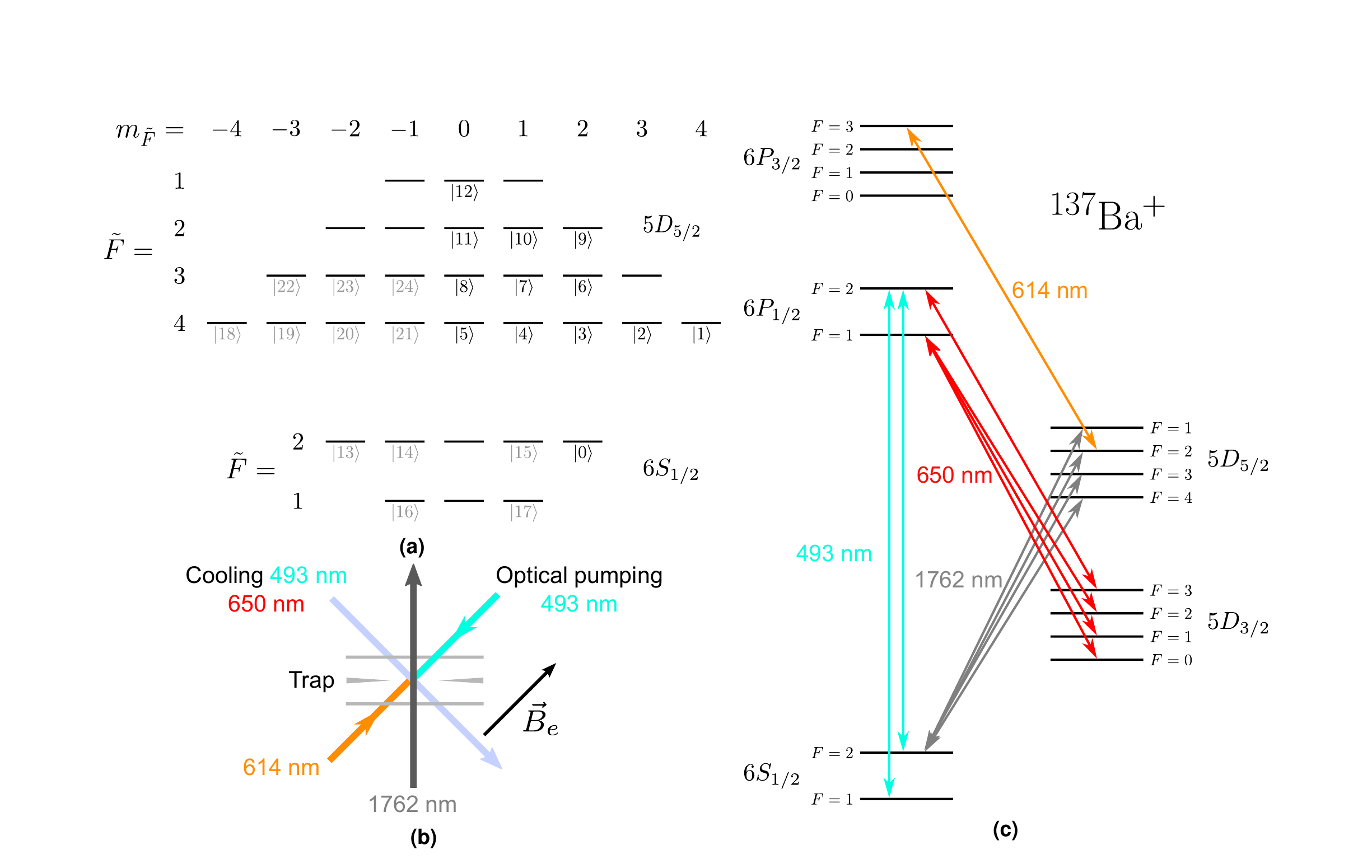
Energy-level schematic of ¹³⁷Ba⁺ from Low, White & Senko, npj Quantum Inf. 11, 85 (2025)[25]P. J. Low, B. White & C. Senko (2025). Control and readout of a 13-level trapped ion qudit. npj Quantum Inf. 11, 85.. The qubit is encoded in the two hyperfine levels of the {}^2S_{1/2} ground state; 493 nm light cools and detects, 650 nm repumps from {}^2D_{3/2}, and 1762 nm / 614 nm light can shelve population in {}^2D_{5/2} for readout.
Interactive: Ion Chain Normal Modes
What you are seeing: A chain of trapped ions acts like a set of coupled pendulums. Each normal mode is a collective vibration where all ions oscillate with a specific pattern of amplitudes and phases. The bar chart on the right shows the mode eigenvector — how much each ion moves in that mode.
Mathematically, the modes are found by diagonalizing the Coulomb-spring matrix: the ions' equilibrium positions balance the trap confinement against mutual Coulomb repulsion, and small displacements obey Mq̈_i = -∑_j A_{ij} q_{j}. The eigenvalues of A give the 3N mode frequencies. As N grows, the mode spectrum becomes crowded, making it harder to address a single mode for gates — one reason large crystals are eventually broken into shuttled zones.
Try this: Mode 1 (center-of-mass) moves all ions together. Mode 2 (breathing) moves outer ions more than inner ones. In transverse modes, ions oscillate perpendicular to the chain axis. The eigenvectors shown use a uniform-spacing approximation.
5
1 / 5
Cooling to the Quantum Ground State
Before quantum gates can work, the ion must be cooled to its motional ground state — a temperature measured in microkelvin. This requires a cascade of laser cooling techniques.
A trapped ion loaded into the trap has thermal energy corresponding to hundreds of Kelvin — far too hot for quantum operations. The ion must be cooled to near its motional ground state (n̄ ≪ 1 phonons) before sideband gates can work with high fidelity. This is achieved through a sequence of laser cooling stages, each reaching lower temperatures[3]D. J. Wineland et al. (1998). Experimental issues in coherent quantum-state manipulation of trapped atomic ions. J. Res. Natl. Inst. Stand. Technol. 103, 259.[10]H. Häffner et al. (2008). Quantum computing with trapped ions. Phys. Rep. 469, 155–203..
Doppler Cooling
The first stage is Doppler cooling: a laser is tuned slightly to the red (lower frequency) of a strong atomic transition. Ions moving toward the laser see a Doppler shift that brings the light closer to resonance, so they absorb more photons and are pushed backward. Ions moving away absorb less. The net effect is a damping force that cools the ion.
The minimum temperature — the Doppler limit — is set by the recoil energy from spontaneous emission: where Γ is the natural linewidth of the cooling transition. For typical ion species, this gives T_D ~ 0.5–1 mK, corresponding to average motional excitations of n̄ ~ 10–100 — not yet cold enough for high-fidelity gates[3]D. J. Wineland et al. (1998). Experimental issues in coherent quantum-state manipulation of trapped atomic ions. J. Res. Natl. Inst. Stand. Technol. 103, 259..
Resolved-Sideband Cooling
To go below the Doppler limit, we use resolved-sideband cooling. In the Lamb-Dicke regime, the motional sidebands are spectrally resolved from the carrier. A laser tuned to the red sideband drives transitions |e,n⟩ → |g,n−1⟩, removing one quantum of motion each time the ion cycles. After each transition, the internal state is repumped to |e⟩ with a second laser, and the cycle repeats. Here |e⟩ and |g⟩ denote the excited and ground internal states of the cooling transition, distinct from the qubit labels |0⟩ and |1⟩.
The cooling rate is limited by the sideband Rabi frequency Ω_η = ηΩ. In the Lamb-Dicke regime, the probability of heating (absorbing on the blue sideband) is suppressed by η². In the ideal Lamb–Dicke limit, sideband cooling leaves the ion with an average motional excitation of: With η ~ 0.01–0.1, the final temperature corresponds to n̄_f ~ 10⁻⁴–10⁻², meaning the ground-state probability P(n=0) = 1/(1+n̄_f) exceeds 99%. In practice, ground-state probabilities exceeding 99.9% are routine in trapped-ion experiments[3]D. J. Wineland et al. (1998). Experimental issues in coherent quantum-state manipulation of trapped atomic ions. J. Res. Natl. Inst. Stand. Technol. 103, 259.[1]C. Monroe et al. (2021). Programmable quantum simulations of spin systems with trapped ions. Rev. Mod. Phys. 93, 025001..
Electromagnetically-Induced Transparency (EIT) Cooling
In systems with many motional modes or where continuous sub-Doppler cooling is desirable, a variant called EIT cooling uses quantum interference to suppress the carrier transition while enhancing the red sideband. This allows continuous cooling below the Doppler limit without the discrete cycles of sideband cooling, and is particularly useful for large ion crystals where multiple modes must be cooled simultaneously[1]C. Monroe et al. (2021). Programmable quantum simulations of spin systems with trapped ions. Rev. Mod. Phys. 93, 025001..
Heating: The Enemy of Ion Traps
Despite cooling, ions constantly heat due to fluctuating electric fields from noise on trap electrodes. The heating rate n̄̇ scales roughly as d⁻⁴ where d is the ion-electrode distance, meaning smaller traps (for higher speed and integration) suffer worse heating. Heating rates of n̄̇ ~ 1–100 phonons/s are typical, and are one of the key factors limiting gate fidelity in long computations. The microscopic origins of this anomalous heating and its mitigation — including cryogenic operation — are discussed in the Trap Fabrication section[1]C. Monroe et al. (2021). Programmable quantum simulations of spin systems with trapped ions. Rev. Mod. Phys. 93, 025001..
~500 K
Ion Source
Thermal ions from oven or photoionization
~1 mK
Doppler Cooling
Red-detuned laser, limits set by recoil
~10 μK
Sideband Cooling
Resolved sideband transitions
~0.1 μK
Ground State
n̄ < 0.01, ready for gates
Interactive: Cooling Stages
What you are seeing: The probability distribution P(n) of finding the ion in motional state n (the number of phonons). The y-axis now adapts to each stage so the shape of every distribution is clearly visible. The highlighted bar is n = 0, the motional ground state required for quantum gates.
Try this: Step through the stages. Notice how thermal ions have a broad distribution (truncated at n=25), while ground-state cooling concentrates nearly all probability into n = 0.
Schematic⟨n⟩ ≈ 30.0 phonons
Ion freshly loaded into the trap. The motional state is thermal with a broad distribution spanning many phonon numbers — far too hot for quantum gates.
Laser Control & Quantum Gates
Quantum gates are performed by shining precisely tuned laser beams at trapped ions. Carrier transitions, sideband operations, and Mølmer-Sørensen entangling gates form the universal gate set.
Unlike superconducting qubits that use microwave pulses, trapped-ion qubits are controlled with laser beams (or microwave fields in some implementations). The laser frequency, phase, pulse duration, and intensity determine which quantum operation is performed. A complete universal gate set requires single-qubit rotations and at least one two-qubit entangling gate[1]C. Monroe et al. (2021). Programmable quantum simulations of spin systems with trapped ions. Rev. Mod. Phys. 93, 025001.[10]H. Häffner et al. (2008). Quantum computing with trapped ions. Phys. Rep. 469, 155–203..
For the sideband and entangling gates below, the ion chain must first be cooled to near its motional ground state — the cascade of Doppler and resolved-sideband cooling described in the previous section. Sideband transitions remove or add individual phonons, so a thermal ion with many phonons would blur the discrete spectrum these gates rely on.
Single-Qubit Gates
A single laser beam resonant with the qubit transition frequency drives Rabi oscillations between |0⟩ and |1⟩. In the rotating wave approximation, the interaction Hamiltonian is:
where Ω is the Rabi frequency (proportional to laser intensity and transition dipole moment), and φ is the laser phase. The rotation axis in the equatorial plane of the Bloch sphere is set by φ. A π-pulse with Ω t_π = π flips |0⟩ → |1⟩, while a π/2-pulse creates an equal superposition.
The rotation operator for a single-qubit gate is: By varying θ (pulse area) and φ (laser phase), any single-qubit state can be prepared; arbitrary single-qubit unitaries additionally use virtual Z phase updates or short pulse sequences. State-of-the-art trapped-ion systems achieve single-qubit gate fidelities exceeding 99.99%[13]C. J. Ballance et al. (2016). High-fidelity quantum logic gates using trapped-ion hyperfine qubits. Phys. Rev. Lett. 117, 060504..
From Atom-Laser Interaction to Sidebands
A laser field couples the ion's internal transition through the electric-dipole interaction. In the rotating-wave approximation and in a frame rotating at the laser frequency, the interaction Hamiltonian is:
where Δ = ω_L − ω_0 is the laser detuning from the atomic transition, k is the laser wavevector, and x̂ is the ion's position operator. Because the ion is harmonically trapped, we can write x̂ = x_0(a + a†) with x_0 = √(ℏ/(2mω_m)). The exponent then contains the Lamb-Dicke parameter η = kx_0:
In the Lamb-Dicke regime (η ≪ 1) we expand the exponential to first order: The three terms that emerge correspond to the three resonant transitions shown below. When Δ = 0 we drive the carrier (no phonon change); when Δ = −ω_m we drive the red sideband (qubit excitation plus phonon annihilation); and when Δ = +ω_m we drive the blue sideband (qubit excitation plus phonon creation). This is the trapped-ion Jaynes–Cummings Hamiltonian.
Sideband Transitions
Setting the laser detuning to Δ = ±ω_m selects the sideband Hamiltonians: The red sideband (RSB) removes one phonon while exciting the qubit; the blue sideband (BSB) adds one phonon while exciting the qubit. These are the trapped-ion analog of the Jaynes-Cummings interaction. The sideband Rabi frequency is reduced by the Lamb-Dicke parameter η ≪ 1, making sideband operations slower than carrier transitions but highly selective[3]D. J. Wineland et al. (1998). Experimental issues in coherent quantum-state manipulation of trapped atomic ions. J. Res. Natl. Inst. Stand. Technol. 103, 259.[10]H. Häffner et al. (2008). Quantum computing with trapped ions. Phys. Rep. 469, 155–203..
The Cirac–Zoller Gate
Before the Mølmer–Sørensen gate, the first concrete proposal for a trapped-ion quantum computer was the Cirac–Zoller (CZ) gate, introduced by Ignacio Cirac and Peter Zoller in 1995[2]J. I. Cirac & P. Zoller (1995). Quantum Computations with Cold Trapped Ions. Phys. Rev. Lett. 74, 4091–4094.. In this scheme, the collective motional mode of a string of ions acts as a quantum bus that mediates interactions between internal qubit states. Unlike the MS gate, the CZ gate requires the ions to be cooled to the motional ground state before the gate begins.
The gate uses three sideband pulses. Here |g⟩ and |e⟩ denote two internal atomic states of the control ion used for the bus transition, not necessarily the logical qubit labels. First, a π-pulse on the red sideband of the control ion swaps its internal state onto a single phonon of the bus mode:
Next, a 2π-pulse on the target ion couples its internal ground state |g⟩_t to an auxiliary excited state |r⟩_t through the same motional mode. This pulse returns the target ion to |g⟩_t but imparts a minus sign only when the bus holds one phonon:
Finally, a second π-pulse on the control ion swaps the phonon back into the control qubit. The net effect is a controlled-phase gate, equivalent to a CNOT up to single-qubit rotations.
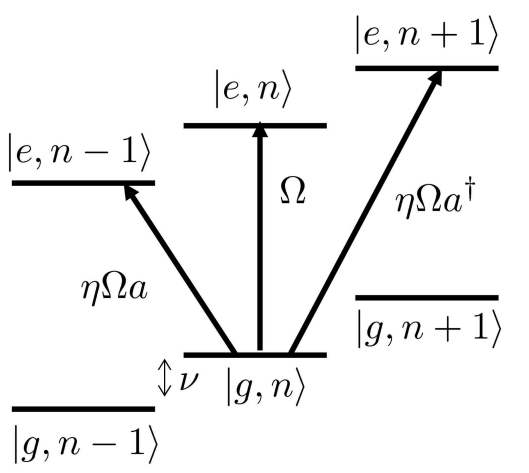
Coupling to the atom + trap levels according to Hamiltonians (2), (3) and (4), respectively, in lowest-order Lamb-Dicke expansion.
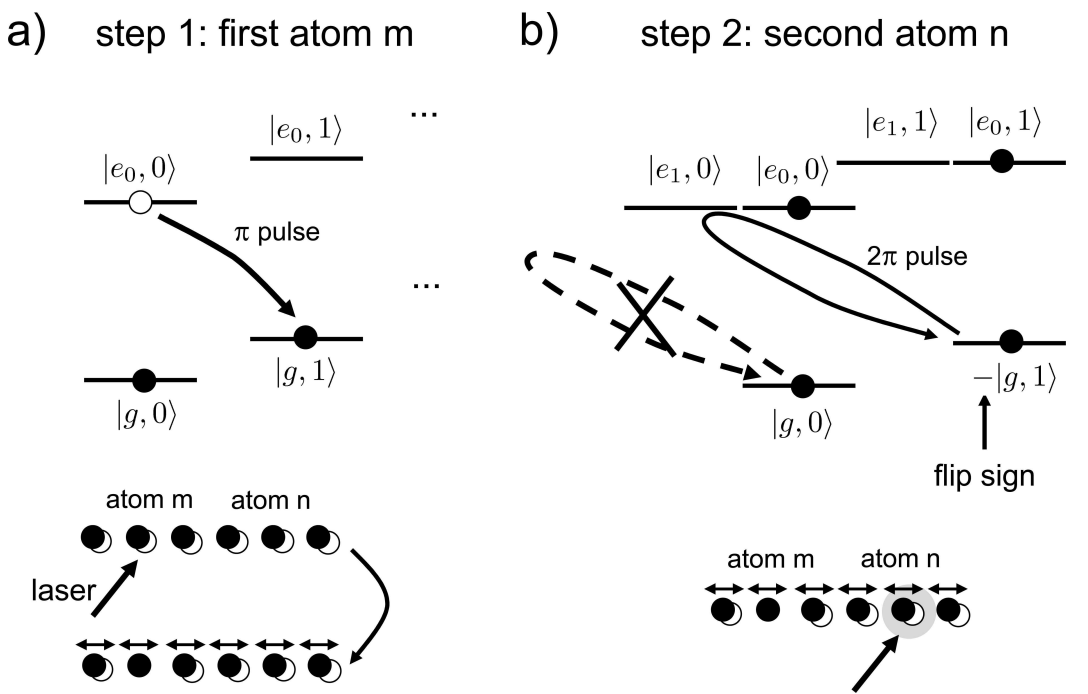
FIG. 2: The two-qubit quantum gate with trapped ions. a) First step: the qubit of the first atom is swapped to the motional bus with a π-pulse on the lower motional sideband. b) Second step: the state |g,1⟩ acquires a minus sign due to a 2π-rotation via the auxiliary atomic level |r_1⟩. Adapted from Wineland et al. (2003)[26]D. J. Wineland, C. Monroe, W. M. Itano, D. Leibfried, B. E. King & D. M. Meekhof (2003). Quantum information processing with trapped ions. Phil. Trans. R. Soc. Lond. A 361, 1349–1361..
The Cirac–Zoller gate was historically important because it proved that scalable quantum logic with trapped ions is possible. Its main limitation is the ground-state cooling requirement and the need to address individual ions with separate laser beams. These constraints motivated the development of the Mølmer–Sørensen gate, which is far more tolerant of thermal phonons than the CZ gate and can be driven with global laser beams[10]H. Häffner et al. (2008). Quantum computing with trapped ions. Phys. Rep. 469, 155–203..
The Mølmer-Sørensen Gate
The Mølmer-Sørensen (MS) gate is the dominant two-qubit entangling gate for trapped ions. It uses two laser beams with frequencies tuned symmetrically around the carrier — one near the red sideband and one near the blue sideband — of a collective motional mode. The two tones are detuned from the sideband resonances by a small amount δ, so the ion motion is driven off-resonantly rather than resonantly displaced[4]A. Sørensen & K. Mølmer (1999). Quantum Computation with Ions in Thermal Motion. Phys. Rev. Lett. 82, 1971–1974.[11]D. Leibfried et al. (2003). Experimental demonstration of a robust, high-fidelity geometric two ion-qubit phase gate. Nature 422, 412–415..
The resulting bichromatic Hamiltonian is time-dependent: This creates an oscillating spin-dependent force. Each joint spin state in the σ_x eigenbasis |±⟩_x is pushed back and forth in motional phase space at frequency δ. After a gate time t_g = 2π/δ the state returns to its original motional state, having traced a closed loop. The loop area — and therefore the geometric phase — depends on the spin state: states with the same displacement (|++⟩_x and |--⟩_x) enclose a larger area than states with opposite displacement (|+-⟩_x and |-+⟩_x). For a properly chosen pulse, the accumulated phase is:
This is a maximally entangling gate. Combined with single-qubit rotations, it forms a universal gate set. The MS gate has been demonstrated with fidelities exceeding 99.9% and is far more tolerant of thermal phonons than the Cirac–Zoller gate — a crucial advantage for scalability — although low motional excitation and low heating during the gate are still important for the highest fidelities[11]D. Leibfried et al. (2003). Experimental demonstration of a robust, high-fidelity geometric two ion-qubit phase gate. Nature 422, 412–415.[13]C. J. Ballance et al. (2016). High-fidelity quantum logic gates using trapped-ion hyperfine qubits. Phys. Rev. Lett. 117, 060504.[14]J. P. Gaebler et al. (2016). High-fidelity universal gate set for ⁹Be⁺ ion qubits. Phys. Rev. Lett. 117, 060505..
Control Optics Chain
The laser control chain spans from the laser source to the ion. Key components include:
- •Ultra-stable laser — typically a diode or fiber laser stabilized to a high-finesse cavity, with linewidth ≲ 1 kHz for optical qubits or Raman beam pairs; microwave-driven hyperfine qubits have different stability requirements
- •Acousto-optic modulators (AOMs) — switch laser pulses on/off and control frequency/phase with MHz bandwidth
- •Beam delivery — single-mode fibers or free-space optics deliver beams to the trap with sub-micron pointing stability
- •Objective lens — high-NA lens focuses the beam to a spot size of ~1 μm at the ion position
The total optical path must be phase-stable to better than ~0.1 rad during a gate, requiring active vibration isolation and temperature stabilization[1]C. Monroe et al. (2021). Programmable quantum simulations of spin systems with trapped ions. Rev. Mod. Phys. 93, 025001..
Mølmer–Sørensen gate in words
- 1. Two laser tones are applied simultaneously: one near the red sideband and one near the blue sideband, both detuned from exact resonance by δ.
- 2. The bichromatic field exerts an oscillating spin-dependent force on the ions: the direction of the push depends on the joint spin state in the σ_x basis.
- 3. Each spin state traces a closed loop in motional phase space over gate time t_g = 2π/δ. The loops for |++⟩_x and |--⟩_x enclose a different area than those for |+-⟩_x and |-+⟩_x.
- 4. The enclosed area gives a geometric phase Φ_MS = π/2 that implements the entangling unitary U_MS = exp(−iπ/4 σ_x^(i) σ_x^(j)).
State-Dependent Fluorescence Readout
Detecting the quantum state of a single atom with near-perfect fidelity. One state glows brightly; the other stays dark.
Trapped-ion readout is remarkably direct and efficient compared to other platforms. The qubit states |0⟩ and |1⟩ are chosen to have very different fluorescence properties under a specific laser wavelength. One state scatters thousands of photons per millisecond (bright); the other is off-resonant and scatters almost none (dark)[3]D. J. Wineland et al. (1998). Experimental issues in coherent quantum-state manipulation of trapped atomic ions. J. Res. Natl. Inst. Stand. Technol. 103, 259.[10]H. Häffner et al. (2008). Quantum computing with trapped ions. Phys. Rep. 469, 155–203..
For ¹⁷¹Yb⁺, the readout laser is tuned near the {}^2S_{1/2} → {}^2P_{1/2} transition at λ = 369.5 nm. The |F=1⟩ state is resonant with the cycling transition and scatters photons continuously. The |F=0⟩ state is 12.6428 GHz away — far enough that the scattering rate is suppressed by roughly 10⁶. A photomultiplier tube (PMT) or electron-multiplying CCD (EMCCD) camera counts the scattered photons.
The Readout Process
The readout protocol is simple but powerful:
- Apply readout laser — a weak, resonant beam at the cycling transition for typically ~0.1–1 ms
- Collect fluorescence — a high-NA objective lens collects ~5–10% of emitted photons into a PMT or camera
- Threshold photon counts — above threshold = bright state (|1⟩); below = dark state (|0⟩)
The number of photons detected from the bright state follows Poisson statistics with mean N_b ~ 10–50, while the dark state gives N_d ~ 0.01–0.1 due to off-resonant scattering. The two distributions are almost perfectly separated, enabling single-shot readout fidelities exceeding 99.9%[1]C. Monroe et al. (2021). Programmable quantum simulations of spin systems with trapped ions. Rev. Mod. Phys. 93, 025001..
Direct Readout vs Shelving
Not all qubit types offer the convenient bright/dark contrast of ¹⁷¹Yb⁺. Some hyperfine qubits, such as ⁴³Ca⁺, have both qubit states in the ground-state manifold with similar fluorescence. For these, one state is first mapped to a long-lived metastable state (e.g., |D⟩ = |{}^2D_{5/2}⟩ in Ca⁺, with lifetime ~1 s) using a π-pulse. This process is called shelving: the population is 'shelved' in a state that does not fluoresce. The readout laser then addresses the remaining population, and the presence or absence of fluorescence reveals the original qubit state[10]H. Häffner et al. (2008). Quantum computing with trapped ions. Phys. Rep. 469, 155–203..
The shelving/readout sequence can be summarized as:
The π-pulse selectively transfers only one qubit state to the metastable level, leaving the other in the bright cycling transition. Optical qubits (which use a ground state and a metastable excited state as |0⟩ and |1⟩) also rely on shelving-like readout, since one qubit state is already long-lived.
Detection Chain
The detection apparatus spans from the ion to the computer. Photons emitted by the ion are collected by a high-NA objective lens (typically NA ~ 0.2–0.6) mounted outside the vacuum chamber. The lens focuses photons onto either:
- •PMT — fast, single-photon sensitive, but no spatial resolution. Count rates up to ~10⁶ counts/s
- •EMCCD camera — spatial resolution to image multiple ions simultaneously, but slower readout. Enables parallel readout of ion arrays
- •Superconducting nanowire single-photon detectors — emerging technology with near-unity quantum efficiency and picosecond timing
The total photon collection and detection efficiency is typically η_det ~ 0.5–5%. Despite this modest efficiency, the high scattering rate of bright-state ions provides enough signal for excellent discrimination. With high-fidelity gates and readout in hand, the next challenge is to scale the system and protect it with quantum error correction[1]C. Monroe et al. (2021). Programmable quantum simulations of spin systems with trapped ions. Rev. Mod. Phys. 93, 025001..
Trap Fabrication & Materials
How ion traps are built — from gold electrodes on sapphire substrates to the surface contaminants that limit coherence.
Unlike superconducting qubits, which rely on nanometer-scale lithography and Josephson junctions, trapped-ion traps are built from comparatively large metal electrodes patterned on insulating substrates — most commonly gold on sapphire or silicon[1]C. Monroe et al. (2021). Programmable quantum simulations of spin systems with trapped ions. Rev. Mod. Phys. 93, 025001.. The electrode geometry defines the trapping potential, and even nanometer-scale imperfections can introduce stray electric fields that heat the ions out of the motional ground state.
Surface-Electrode Traps
The dominant geometry for modern ion traps is the surface-electrode trap: a flat chip with metal electrodes deposited on its surface. The ions are trapped tens to hundreds of micrometers above the chip, where the RF and DC fields create a 3D pseudopotential well. This planar geometry is compatible with microfabrication techniques and allows complex trap layouts with multiple zones for shuttling[9]J. M. Pino et al. (2021). Demonstration of the trapped-ion quantum CCD computer architecture. Nature 592, 209–213.[1]C. Monroe et al. (2021). Programmable quantum simulations of spin systems with trapped ions. Rev. Mod. Phys. 93, 025001..
A typical surface trap consists of:
- •Substrate — sapphire or silicon, polished to sub-nm roughness
- •Electrodes — gold (1–5 μm thick) or aluminum, patterned by photolithography with feature sizes of 5–50 μm
- •Dielectric gaps — 2–20 μm between electrodes, kept small to reduce RF pickup and field distortion
- •Interconnects — wire bonds or through-silicon vias connect electrodes to control electronics outside the vacuum chamber
The ion-electrode distance is a critical parameter. For a fixed RF voltage, the trap frequency scales roughly as , the motional heating rate scales as , and smaller traps demand tighter laser focusing tolerance. Typical values are , with research traps pushing below 30 μm for higher speed and integration density.
Anomalous Heating: The Surface Problem
The dominant decoherence mechanism in trapped-ion systems is not spontaneous emission or laser noise — it is anomalous heating. Even at room temperature and ultra-high vacuum, the ions experience fluctuating electric fields that add phonons to their motion. The heating rate n̄̇ — phonons added per second — scales approximately as:
where e is the elementary charge, S_E(ω_m) is the power spectral density of electric-field noise at the trap frequency, and the scaling holds for a patch-potential noise model. For typical parameters, heating rates of n̄̇ ~ 1–100 phonons/s are common — enough to degrade gate fidelity within milliseconds[1]C. Monroe et al. (2021). Programmable quantum simulations of spin systems with trapped ions. Rev. Mod. Phys. 93, 025001..
The origin of anomalous heating is still an active research area. Leading candidates include:
- •Surface adsorbates — hydrocarbons and other contaminants on electrode surfaces create fluctuating patch potentials
- •Two-level systems (TLS) — amorphous dielectric layers on metal electrodes act as fluctuating dipoles
- •Johnson-Nyquist noise — resistive losses in electrodes and filters generate thermal noise currents
Critically, heating rates can drop by 1–3 orders of magnitude (or more) when traps are cooled to cryogenic temperatures (4 K). This is one reason some next-generation ion trap systems operate in cryostats — not to cool the ions (lasers do that), but to freeze out the surface noise sources[1]C. Monroe et al. (2021). Programmable quantum simulations of spin systems with trapped ions. Rev. Mod. Phys. 93, 025001..
Ion Loading
Before quantum operations can begin, atoms must be ionized and trapped. There are two main approaches:
- •Thermal oven — atoms are heated in a small oven and effuse into the trap region. A laser ionizes them via resonant photoionization (often a two-step process). Simple and reliable, but introduces contamination over time
- •Photoionization — a neutral atomic beam (from an oven or laser-ablated target) is ionized by resonant laser light. More efficient and cleaner, allowing deterministic loading of single ions
Once an ion is loaded, it is Doppler-cooled and then shuttled to a storage or interaction zone. The loading zone is typically isolated from the main computation zones to prevent contamination from the atomic source.
Key trap fabrication parameters
Substrate
Sapphire / Si
Electrode material
Gold / Al
Ion-electrode distance
Electrode gap
Typical heating rate
Heating at 4 K
Trap frequency
Vacuum
Vacuum, Cryogenics & Environment
Trapped ions are exquisitely sensitive to their environment. Ultra-high vacuum, vibration isolation, and magnetic shielding are as critical as the trap itself.
A single trapped ion is a nanometer-scale object floating in free space, held only by electromagnetic fields. This makes it extraordinarily sensitive to its surroundings. Collisions with background gas molecules, vibrations that shake the laser beams, and fluctuating magnetic fields can all destroy quantum coherence. The environmental control system for a trapped-ion quantum computer is as complex as the trap itself[1]C. Monroe et al. (2021). Programmable quantum simulations of spin systems with trapped ions. Rev. Mod. Phys. 93, 025001.[10]H. Häffner et al. (2008). Quantum computing with trapped ions. Phys. Rep. 469, 155–203..
Ultra-High Vacuum
The ion must remain trapped for hours or days without colliding with a background gas molecule. This requires ultra-high vacuum (UHV) conditions of ≲ 10⁻¹¹ mbar — roughly one billionth of atmospheric pressure. At this pressure, the mean free path of a gas molecule exceeds 10⁶ km, and the collision rate with the ion is below ~1 per hour.
Achieving UHV requires a multi-stage pumping system:
- •Turbomolecular pump — removes the bulk of the gas down to ~10⁻⁹ mbar
- •Ion getter pump — chemically binds residual reactive gases (H₂, N₂, O₂, CO)
- •Titanium sublimation pump — deposits fresh titanium films that adsorb residual gases, reaching the 10⁻¹¹ mbar regime
- •Bake-out — the entire vacuum chamber is heated to ~150–200 °C for days to desorb water and hydrocarbons from surfaces
The vacuum chamber itself is typically made of non-magnetic stainless steel or titanium, with fused silica viewports for laser access. Every seal, feedthrough, and viewport is a potential leak or virtual leak (trapped gas pockets), so chamber design is a specialized art[1]C. Monroe et al. (2021). Programmable quantum simulations of spin systems with trapped ions. Rev. Mod. Phys. 93, 025001..
Vibration Isolation
Laser beams must be focused to a spot size of ~1 μm at the ion position, and their pointing must be stable to better than ~0.1 μm. Any vibration of the trap relative to the optics (or vice versa) blurs the beam and reduces gate fidelity.
Vibration isolation uses a combination of:
- •Passive isolation — pneumatic optical tables with resonant frequencies ≲ 1 Hz, supporting the vacuum chamber and optics
- •Active stabilization — piezoelectric mirrors correct beam pointing in real time using a reference beam
- •Fiber delivery — delivering laser light via single-mode fibers eliminates free-space path-length fluctuations (though fiber coupling still requires stability)
Building vibrations, acoustic noise, and even footsteps in the lab can excite resonant modes of the optical table. Advanced labs use seismic sensors and active feedback to suppress vibrations across a broad bandwidth.
Magnetic Shielding
For Zeeman qubits and some hyperfine qubits, the energy splitting depends on the magnetic field. Fluctuations in the ambient field — from elevators, power lines, or the Earth's own variations — cause dephasing. Magnetic shielding uses:
- •Mu-metal shields — high-permeability alloy cylinders that divert magnetic field lines around the trap region
- •Helmholtz coils — three pairs of coils that null the residual field and provide a stable quantization axis
- •Active field cancellation — fluxgate sensors measure the field and feedback coils cancel it in real time
These shielding methods are typically combined to suppress both static and time-varying magnetic fields, reducing the residual field at the ion to nanotesla levels or below.
Cryogenic Operation
While many ion traps operate at room temperature, there is a growing trend toward cryogenic ion traps at 4 K. The motivation is not to cool the ion (lasers do that far more effectively) but to suppress the anomalous heating from electrode surfaces. Cooling the trap chip to 4 K can reduce heating rates by 1–3 orders of magnitude (or more), enabling longer gate sequences and higher-fidelity operations.
Cryogenic traps are typically mounted in a closed-cycle cryostat with optical access through windows. The challenges include:
- •Thermal contraction — materials shrink by ~0.1% when cooled, potentially cracking electrodes or delaminating films
- •Vibration from cryocoolers — pulse tube and Gifford-McMahon coolers produce significant vibration, requiring careful mechanical isolation
- •Window condensation and birefringence — cryogenic windows can distort laser polarization, affecting gate fidelity
Despite these challenges, cryogenic operation is an important technique for suppressing anomalous heating, but many state-of-the-art commercial systems — including Quantinuum's H-series processors — currently operate at room temperature[1]C. Monroe et al. (2021). Programmable quantum simulations of spin systems with trapped ions. Rev. Mod. Phys. 93, 025001..
300 K
Room Temperature
Trap chip, laser beam delivery, imaging optics
4 K
Cryogenic Shield
Some traps cooled to reduce anomalous heating
~1 mK
Doppler Cooled Ion
Laser cooling to Doppler limit
~0.1 μK
Ground-State Cooled
Sideband cooling completes
Ion Crystals in the Lab
What trapped ions actually look like under fluorescence — from small linear chains to two-dimensional Coulomb crystals.
In a linear Paul trap, laser-cooled ions repel each other electrostatically and form Coulomb crystals — ordered structures that can be linear, 2D, or 3D depending on ion number and trap geometry. Each bright spot in the images below is a single trapped ion. Thanks to ultra-high vacuum and deep confinement, these ions can remain trapped for days[24]Stockholm University, Trapped Ion Quantum Technology Group (2025). Quantum Computation with Trapped Ions. https://qtech.fysik.su.se/quantum-computation.html..
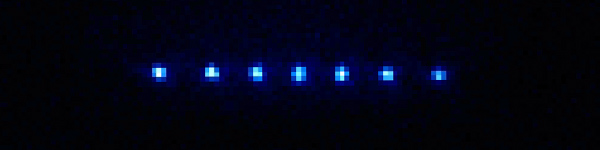
7 ions

8 ions
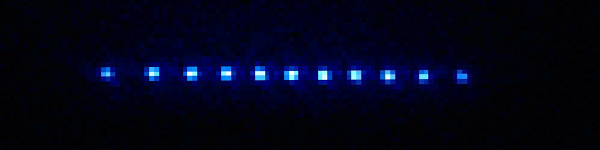
11 ions
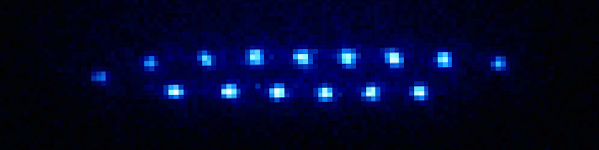
2D Coulomb crystal
Coulomb crystals of laser-cooled trapped ions. Each bright spot is a single ion. Use the arrows to scroll through images.
Quantum Jumps
The video below shows quantum jumps of six trapped-ion qubits — the discrete, random transitions between bright and dark states that are visible through fluorescence detection. This is the same readout mechanism used to determine the quantum state with errors below 10⁻³ in many trapped-ion experiments[24]Stockholm University, Trapped Ion Quantum Technology Group (2025). Quantum Computation with Trapped Ions. https://qtech.fysik.su.se/quantum-computation.html..
Quantum jumps of six trapped-ion qubits observed via state-dependent fluorescence.
Quantum Error Correction for Trapped Ions
From shuttling architectures to erasure conversion — how trapped-ion systems are engineering a path to fault-tolerant quantum computing.
Trapped-ion qubits have physical error rates among the lowest of any platform. With single-qubit gate fidelities of ~99.99% and two-qubit gate fidelities exceeding 99.9%, the physical error rate is p ~ 10⁻³ per gate[13]C. J. Ballance et al. (2016). High-fidelity quantum logic gates using trapped-ion hyperfine qubits. Phys. Rev. Lett. 117, 060504.[14]J. P. Gaebler et al. (2016). High-fidelity universal gate set for ⁹Be⁺ ion qubits. Phys. Rev. Lett. 117, 060505.[17]Quantinuum (2025). Helios: 98 barium-ion qubits, 99.921% two-qubit gate fidelity, 48 logical error-corrected qubits. Quantinuum Press Release & arXiv:2511.05465.. However, even this is far too high for useful quantum algorithms. The path to fault tolerance requires quantum error correction — encoding logical qubits across many physical qubits.
Because trapped-ion systems have all-to-all connectivity within a shared trap zone and native high-fidelity entangling gates, they face different QEC challenges and opportunities than nearest-neighbor platforms like superconducting qubits[1]C. Monroe et al. (2021). Programmable quantum simulations of spin systems with trapped ions. Rev. Mod. Phys. 93, 025001.[9]J. M. Pino et al. (2021). Demonstration of the trapped-ion quantum CCD computer architecture. Nature 592, 209–213..
The QCCD Architecture
The leading approach for scaling trapped-ion quantum computers is the Quantum Charge-Coupled Device (QCCD) architecture, proposed by Kielpinski, Monroe, and Wineland in 2002[7]D. Kielpinski et al. (2002). Architecture for a large-scale ion-trap quantum computer. Nature 417, 709–711.. In a QCCD processor, ions are confined in multiple trap zones on a single chip. Some zones are storage zones where qubits are held with minimal decoherence; others are interaction zones where gates are performed. Ions are shuttled between zones by varying electrode voltages.
The shuttling protocol works by creating a moving potential well along the trap axis. By applying time-varying voltages to a sequence of electrodes, the ion is transported smoothly without significant motional excitation — provided the transport is adiabatic with respect to the trap frequencies. Shuttling fidelities exceeding 99.99% have been demonstrated over millimeter-scale distances[9]J. M. Pino et al. (2021). Demonstration of the trapped-ion quantum CCD computer architecture. Nature 592, 209–213..
Storage Zone
Deep, harmonic potential. Minimal noise. Used for idle qubits during computation. Coherence times ~minutes.
Interaction Zone
Two or more ions brought together for gates. Higher noise but fast operations. Gate times ~10–100 μs.
In 2021, Honeywell (now Quantinuum) demonstrated the first fully integrated QCCD processor with 10 ions shuttling between multiple zones to execute quantum algorithms[9]J. M. Pino et al. (2021). Demonstration of the trapped-ion quantum CCD computer architecture. Nature 592, 209–213.. This validated the QCCD as a viable path to scalability.
Native Gates and QEC Overhead
A key advantage of trapped ions is that their native two-qubit entangling gate (the Mølmer-Sørensen gate) naturally realizes an XX rotation. Unlike superconducting systems, which often decompose arbitrary two-qubit gates into CNOTs and single-qubit rotations, trapped-ion systems can directly implement MS gates with arbitrary rotation angles. This reduces the gate overhead for QEC circuits.
For example, a weight-4 surface-code stabilizer measurement on a superconducting system requires 4 CNOTs between one ancilla and four data qubits — each CNOT decomposes into native gates. On an ion trap with native MS gates, the same operation may require fewer native operations due to the direct pairwise coupling[8]C. Ryan-Anderson et al. (2022). Implementing fault-tolerant entangling gates on the five-qubit code and the color code. Phys. Rev. X 12, 011058..
The surface code threshold for trapped-ion systems is estimated at p_th ~ 0.5–1% for circuit-level depolarizing noise, similar to superconducting qubits, but the below-threshold logical error rate scales more favorably due to the higher physical fidelity:
With single-qubit error rates already below 10⁻⁴ and two-qubit error rates near 8 × 10⁻⁴ (with a roadmap toward 10⁻⁴), a distance-7 surface code could achieve logical error rates of ~10⁻⁶ per cycle — competitive with the requirements for early fault-tolerant algorithms[8]C. Ryan-Anderson et al. (2022). Implementing fault-tolerant entangling gates on the five-qubit code and the color code. Phys. Rev. X 12, 011058..
Erasure Conversion
Trapped ions have a unique QEC advantage: erasure errors — where the physical qubit is lost or its location is known — can be detected and converted from standard Pauli errors. If an ion escapes from the trap, the error can be flagged as an erasure rather than an undetected bit flip or phase flip. Motional heating can also be diagnosed by auxiliary measurements, but it is not automatically an erasure.
Erasure errors are fundamentally easier to correct than depolarizing errors because the decoder knows where the error occurred. The threshold for erasure correction is higher, and the overhead to achieve a target logical error rate is lower. Recent theoretical work suggests that trapped-ion systems with erasure conversion could achieve fault-tolerant quantum computing with significantly fewer physical qubits than platforms limited to standard depolarizing noise[20]M.-G. Kang, E. Campbell, and B. Brown (2023). Quantum error correction with metastable states of trapped ions using erasure conversion. PRX Quantum 4, 020358..
Trapped-Ion vs Superconducting QEC Overhead
The table below compares key QEC parameters for trapped-ion and superconducting platforms:
Two-qubit gate fidelity~99.9% (ion) vs ~99.5% (SC)
Physical error rate (p)~10⁻³ (ion) vs ~5×10⁻³ (SC)
Surface code threshold~0.5–1% (both)
Physical qubits per logical qubit (d=11)~220–242 (ion) vs ~220–242 (SC) — same code, layout dependent
Native two-qubit gatesMS (XX) vs CZ/iSWAP
ConnectivityAll-to-all within zone (ion) vs Nearest-neighbor (SC)
While the surface code overhead is similar for both platforms at the same code distance, trapped ions benefit from higher physical fidelity, native two-qubit XX gates, and the potential for erasure conversion. The all-to-all connectivity within a trap zone eliminates SWAP overhead, which can reduce circuit depth by ~2–10× for many algorithms[1]C. Monroe et al. (2021). Programmable quantum simulations of spin systems with trapped ions. Rev. Mod. Phys. 93, 025001.[8]C. Ryan-Anderson et al. (2022). Implementing fault-tolerant entangling gates on the five-qubit code and the color code. Phys. Rev. X 12, 011058..
Research in Practice: NIST Trapped-Ion Program
Real ion-trap hardware from the National Institute of Standards and Technology — from multi-zone transport chips to planar microwave-driven traps.
The NIST trapped-ion quantum computing program pursues proof-of-concept experiments in quantum information processing and quantum control. In addition to pushing the limits of conventional gate-based architectures, the team explores alternative approaches including microwave-driven quantum gates and quantum simulation in 2-D arrays of RF microtraps[23]NIST (2025). Quantum Computing with Trapped Ions. NIST Programs & Projects, https://www.nist.gov/programs-projects/quantum-computing-trapped-ions..
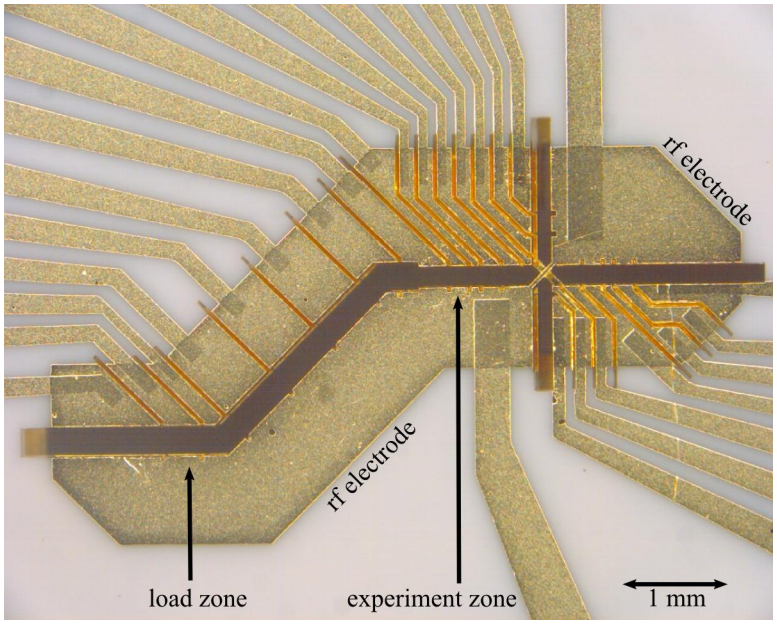
Figure 1. A multi-zone RF Paul trap with load and experiment zones, RF electrodes, and an X-junction.
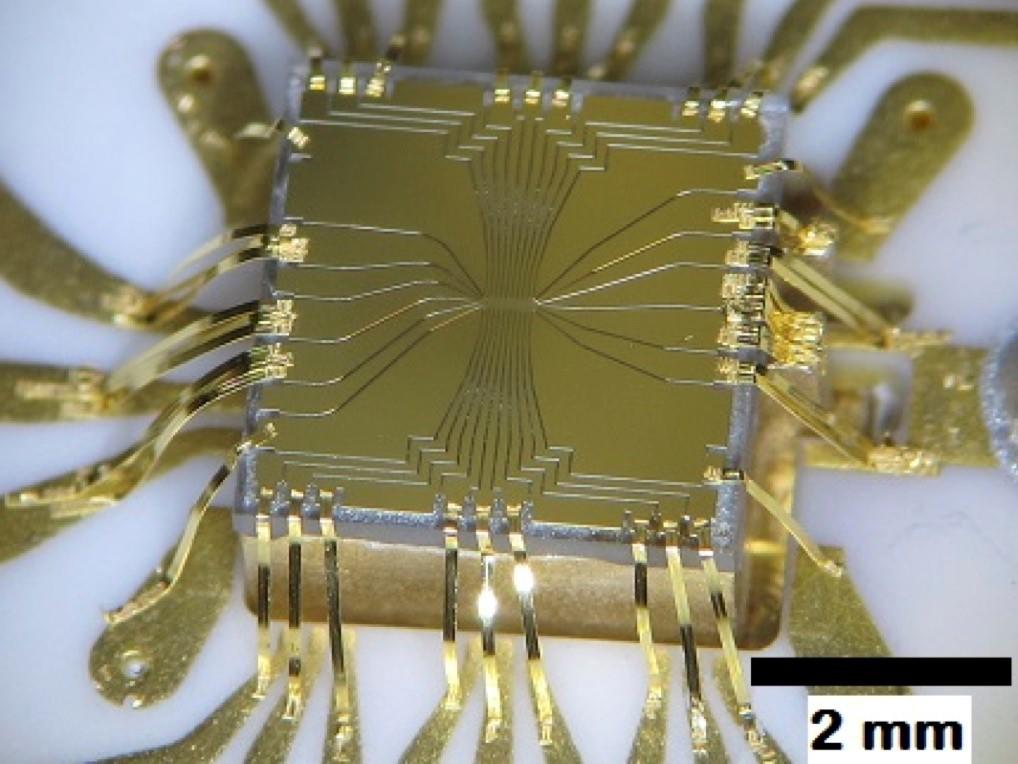
Figure 2. A planar RF ion trap designed for magnetically-driven quantum gates.
NIST ion-trap chips. Left: a multi-zone 3D Paul trap with an X-junction for reordering ions. Right: a planar surface-electrode trap for microwave-driven gates. Images courtesy of NIST.
Multi-Zone 3D Paul Traps
In one experiment, NIST researchers confine magnesium and beryllium ions in linear arrays inside a segmented three-dimensional Paul trap. The chip features two trapping zones for splitting and recombining ion crystals and an X-shaped junction that can reorder ions in a linear array — a key capability for performing quantum gates between arbitrary sets of ions in a single computation.
Using this and similar traps, the group has demonstrated fast, low-excitation ion transport and a high-fidelity universal gate set, including single-qubit operations below the fault-tolerant threshold (less than one error in 25,000 operations) and two-qubit entangling operations with less than one error in 1,000 operations. They have also demonstrated multi-species entangling operations between magnesium and beryllium ions — an integral part of a possible future trapped-ion quantum computer[23]NIST (2025). Quantum Computing with Trapped Ions. NIST Programs & Projects, https://www.nist.gov/programs-projects/quantum-computing-trapped-ions..
Planar Surface-Electrode Traps for Microwave Gates
As an alternative to conventional laser-based gates, NIST is investigating microwave-driven quantum gates. This approach avoids a fundamental error source due to photon scattering and may be technologically easier to scale up. Moving away from traditional segmented linear traps, the team develops micro-fabricated surface-electrode traps that enable flexible 2D geometries and tunable interactions for quantum computing and quantum simulation[23]NIST (2025). Quantum Computing with Trapped Ions. NIST Programs & Projects, https://www.nist.gov/programs-projects/quantum-computing-trapped-ions..
Large-scale devices will also need new methods for quantum-state readout. In collaboration with colleagues at NIST, the program is developing highly efficient superconducting photon detectors integrated into ion traps as part of the micro-fabrication process[23]NIST (2025). Quantum Computing with Trapped Ions. NIST Programs & Projects, https://www.nist.gov/programs-projects/quantum-computing-trapped-ions..
Video Resources
Curated talks and explainers on trapped-ion quantum computing, from first principles to commercial systems.
Trapped-Ion Quantum Computing: Essential Physics
~16 minA clear introduction to how ions serve as qubits, covering optical vs. hyperfine qubits, phonon modes as a quantum bus, sideband cooling, initialization, and readout.
Quantum Information Science with Atomic Trapped Ions — Lecture 1
~60 minChristof Wunderlich lectures on the foundations of quantum information science using atomic trapped ions at the ICTP advanced school.
Trapping Ions for Quantum Computing — Diana Prado Lopes Aude Craik
~10 minNanoNerds walks through the core ideas behind trapping ions for quantum computing, praised as one of the most intuitive explanations available.
Quantum Simulation and Computation with Trapped Ions — Chris Monroe
~60 minChristopher Monroe discusses quantum simulation and computation with trapped ions, drawing on his work at Duke University and IonQ.
Who Is Building It
Trapped-ion systems power the highest-fidelity quantum computers in the world.
IonQ
Tempo: 64 AQ / ~100 physical qubits; 99.99% 2Q fidelity demo on EQC prototypes (2025)
Commercial trapped-ion QC, public cloud access, acquired Oxford Ionics; agreement to acquire SkyWater (pending close)
Quantinuum
Helios: 98 qubits, 99.921% fidelity, 48 logical qubits via high-rate code (2025)
Record fidelities, QCCD shuttling, encoded logical qubits demonstrated
Alpine Quantum Technologies
IBEX Q1: 12 trapped-ion qubits on Amazon Braket (2025)
European trapped-ion QC, ion-photon interfaces, supercomputer hybrid access
Strengths
- •High gate fidelities (~99.9% two-qubit, ~99.99% single-qubit) because atomic transitions are intrinsically narrow and every ion is identical, eliminating fabrication variations.
- •All-to-all connectivity within a shared trap zone because the collective motional bus couples any pair of ions directly, removing SWAP overhead.
- •Identical qubits because every qubit is the same atomic species; there are no junction yield variations or frequency offsets to calibrate out.
- •Long coherence times (~1–10 minutes with dynamical decoupling) because hyperfine clock states are first-order insensitive to magnetic-field noise.
- •Lower QEC overhead than many platforms because the native Mølmer–Sørensen gate implements an XX rotation directly, without decomposing into CNOTs and SWAPs.
Limitations
- •Slow gate operations (~1–100 μs) because sideband Rabi frequencies are suppressed by the Lamb-Dicke parameter η and MS gates require adiabatic phase-space loops, limiting circuit depth.
- •Complex laser systems because addressing individual ions demands sub-micron pointing stability, phase-coherent pulse trains, and often multiple wavelengths for cooling, repumping, and shelving.
- •Scaling requires QCCD shuttling or photonic interconnects because adding ions to one chain crowds the motional mode spectrum and increases heating, making single-mode gates harder.
- •Motional decoherence because fluctuating electric fields on trap electrodes add phonons to the ion motion; the heating rate scales roughly as d⁻⁴, punishing small, fast traps.
- •Heavy infrastructure because the ion must be protected from background gas (UHV), table vibrations, stray magnetic fields, and — in many designs — cryogenic surface noise.
References
Key papers and reviews for further reading on trapped-ion quantum computing.
[1]
C. Monroe et al., Programmable quantum simulations of spin systems with trapped ions, Rev. Mod. Phys. 93, 025001 (2021).
[2]
J. I. Cirac & P. Zoller, Quantum Computations with Cold Trapped Ions, Phys. Rev. Lett. 74, 4091–4094 (1995).
[3]
D. J. Wineland et al., Experimental issues in coherent quantum-state manipulation of trapped atomic ions, J. Res. Natl. Inst. Stand. Technol. 103, 259 (1998).
[4]
A. Sørensen & K. Mølmer, Quantum Computation with Ions in Thermal Motion, Phys. Rev. Lett. 82, 1971–1974 (1999).
[5]
W. Paul, Electromagnetic traps for charged and neutral particles, Rev. Mod. Phys. 62, 531–540 (1990).
[6]
C. Monroe et al., Demonstration of a fundamental quantum logic gate, Phys. Rev. Lett. 75, 4714–4717 (1995).
[7]
D. Kielpinski et al., Architecture for a large-scale ion-trap quantum computer, Nature 417, 709–711 (2002).
[8]
C. Ryan-Anderson et al., Implementing fault-tolerant entangling gates on the five-qubit code and the color code, Phys. Rev. X 12, 011058 (2022).
[9]
J. M. Pino et al., Demonstration of the trapped-ion quantum CCD computer architecture, Nature 592, 209–213 (2021).
[10]
H. Häffner et al., Quantum computing with trapped ions, Phys. Rep. 469, 155–203 (2008).
[11]
D. Leibfried et al., Experimental demonstration of a robust, high-fidelity geometric two ion-qubit phase gate, Nature 422, 412–415 (2003).
[12]
S. Debnath et al., Demonstration of a small programmable quantum computer with atomic qubits, Nature 536, 63–66 (2016).
[13]
C. J. Ballance et al., High-fidelity quantum logic gates using trapped-ion hyperfine qubits, Phys. Rev. Lett. 117, 060504 (2016).
[14]
J. P. Gaebler et al., High-fidelity universal gate set for ⁹Be⁺ ion qubits, Phys. Rev. Lett. 117, 060505 (2016).
[15]
R. Blatt & D. Wineland, Entangled states of trapped atomic ions, Nature 453, 1008–1015 (2008).
[16]
IonQ, IonQ Tempo: 64 algorithmic qubits, 99.99% two-qubit gate fidelity demo with barium ions and EQC, IonQ Press Release & Technical Blog (2025).
[17]
Quantinuum, Helios: 98 barium-ion qubits, 99.921% two-qubit gate fidelity, 48 logical error-corrected qubits, Quantinuum Press Release & arXiv:2511.05465 (2025).
[18]
D. T. C. Allcock, W. C. Campbell, J. Chiaverini, I. L. Chuang, E. R. Hudson, I. D. Moore, A. Ransford, C. Roman, J. M. Sage, D. J. Wineland, omg Blueprint for Trapped Ion Quantum Computing with Metastable States, Appl. Phys. Lett. 119, 214002 (2021).
[19]
Y. Wang et al., Single-qubit quantum memory exceeding ten-minute coherence time, npj Quantum Inf. 3, 32 (2017).
[20]
M.-G. Kang, E. Campbell, and B. Brown, Quantum error correction with metastable states of trapped ions using erasure conversion, PRX Quantum 4, 020358 (2023).
[21]
IonQ, IonQ goes public via SPAC merger with dMY Technology Group III, IonQ Press Release (2021).
[22]
C. D. Bruzewicz, J. Chiaverini, R. McConnell, J. M. Sage, Trapped-ion quantum computing: Progress and challenges, Appl. Phys. Rev. 6, 021314 (2019).
[23]
NIST, Quantum Computing with Trapped Ions, NIST Programs & Projects, https://www.nist.gov/programs-projects/quantum-computing-trapped-ions (2025).
[24]
Stockholm University, Trapped Ion Quantum Technology Group, Quantum Computation with Trapped Ions, https://qtech.fysik.su.se/quantum-computation.html (2025).
[25]
P. J. Low, B. White & C. Senko, Control and readout of a 13-level trapped ion qudit, npj Quantum Inf. 11, 85 (2025).
[26]
D. J. Wineland, C. Monroe, W. M. Itano, D. Leibfried, B. E. King & D. M. Meekhof, Quantum information processing with trapped ions, Phil. Trans. R. Soc. Lond. A 361, 1349–1361 (2003).
Want to see how it compares?
Each hardware platform makes different tradeoffs. See how trapped ions stack up against superconducting qubits, neutral atoms, and photonic systems.
Browse All Platforms